JOHN MACINTYRE & SON · DIAMOND EDUCATION
How to Read a Diamond Report
A diamond report is an important part of how we choose a diamond for you. We use it to understand the grades and details, then look at the individual diamond and how it suits your preferences and price range.
You don’t need to become a diamond expert. That is where our experience comes in. This guide shows you what we look for, what the report tells us and how we use it to help you choose with confidence.
What is a diamond grading report?
A diamond grading report is an independent laboratory’s assessment of an individual diamond. It records what the diamond is and the qualities the laboratory has examined.
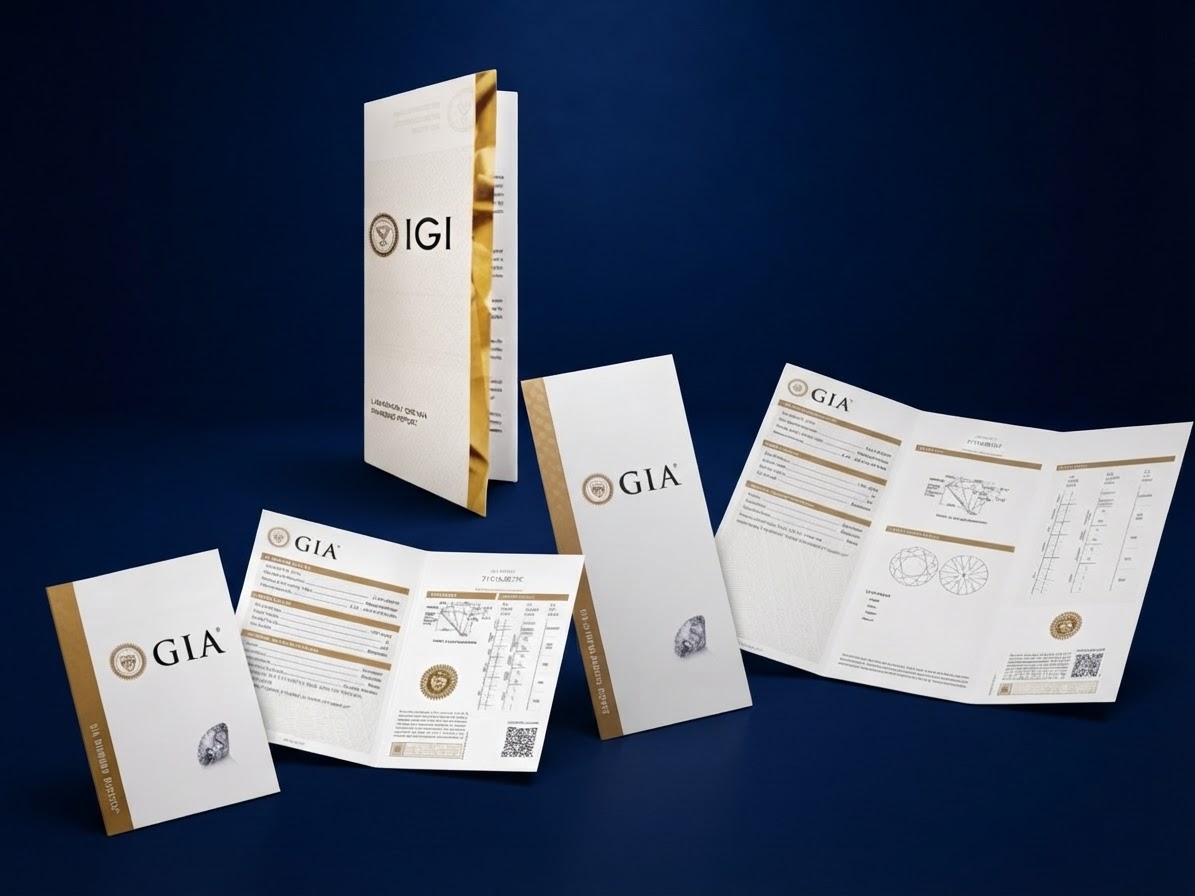
For this guide, we will focus on the reports we use for our individually graded diamonds: GIA for mined diamonds and IGI for lab-grown diamonds. The examples on this page show:
- The laboratory, report number and date.
- The diamond’s shape, cutting style and measurements.
- Its carat weight, colour and clarity grades.
- Its cut grade, where applicable.
- Its polish, symmetry and fluorescence.
Why don’t all fancy shapes have a cut grade?
Fancy shapes include ovals, pears, emerald cuts and other shapes beyond round brilliant.
GIA’s standard overall cut grade applies to eligible round brilliant diamonds in the D to Z range. IGI offers optional cut grading for fancy shapes.
A diamond can be beautifully cut without an overall cut grade on its report. We look at its proportions, craftsmanship and how it handles light, choosing for beauty, fire and sparkle.
Explore diamond shapes and cut quality
Further details depend on the particular report and diamond. These can include proportions, inscriptions, comments and a diagram of clarity characteristics. For example, a GIA Diamond Grading Report includes a clarity plot, while a GIA Diamond Dossier lists clarity characteristics without that plot. We’ll explain these differences as you explore the examples.
From report to finished jewellery
Here is a real example: a 1.24ct H colour, SI1 clarity mined round brilliant diamond, shown in its finished pendant alongside its GIA report.
- Carat: 1.24ct
- Carat measures weight. We chose this 1.24ct diamond to give our customer the presence they wanted in a pendant, within their price range.
- Colour: H
- H is in the near-colourless range. We considered its colour alongside its sparkle and finished setting, bringing together beauty and value for our customer.
- Clarity: SI1
- SI1 means Slightly Included 1, assessed at 10× magnification. This particular diamond was eye-clean, with no inclusions visible to the naked eye — a lovely balance of appearance, size and value.
- Cut: Excellent
- The GIA cut grade is Excellent. We assessed the diamond itself as well as its report, choosing it for its exceptional presence, fire and light return.
- Polish / symmetry: Excellent / Excellent
- Excellent polish and Excellent symmetry describe the finish and precision of its facets. Together with Excellent cut, these made it Triple Excellent; we also looked at how beautifully it sparkled.
- Fluorescence: None
- This diamond’s report records None, matching our preference for individually graded diamonds. Fluorescence alone does not determine whether a diamond can be beautiful.
Our customer wanted a diamond over 1.00ct within a specific price range. We chose this 1.24ct diamond for its beauty — it had exceptional presence, fire and light return, giving it that wonderful sparkle.
H colour and SI1 clarity, it was also eye-clean, with no inclusions visible to the naked eye. Excellent grades for cut, polish and symmetry made it “Triple Excellent”. It brought together the size, beauty and value we wanted for our customer, within their price range.
Why we choose GIA and IGI
We only use GIA for our individually graded mined diamonds. GIA created the 4Cs grading system used around the world and has examined some of the world’s most famous diamonds, including the Hope Diamond. That depth of expertise is why we choose GIA for our individually graded mined diamonds.
We only use IGI for our individually graded lab-grown diamonds. IGI pioneered lab-grown diamond grading in 2005. That specialist experience is why we choose IGI for our individually graded lab-grown diamonds.
IGI continues to use the familiar 4Cs grading system for lab-grown diamonds, including individual colour and clarity grades. GIA now uses “Premium” or “Standard” assessments for colourless to near-colourless lab-grown diamonds. GIA still uses its established 4Cs grading system for mined diamonds.
Their expertise gives us the grading. Our experience helps us find the diamond you’ll love, within your price range.
Explore a diamond report
Three further examples show how report formats differ: a GIA Diamond Dossier for a mined round brilliant, and IGI reports for lab-grown oval and round brilliant diamonds.
0.80ct GIA graded mined round brilliant
D colour · VS1 clarity · Excellent cut, polish and symmetry · Fluorescence: None.
2.02ct IGI graded lab-grown oval
D colour · Flawless clarity · Excellent polish and symmetry · Fluorescence: None.
1.02ct IGI graded lab-grown round brilliant
E colour · Internally Flawless clarity · Ideal cut · Excellent polish and symmetry · Fluorescence: None.
These educational reports use fictional example numbers and QR codes that cannot verify a diamond. The original grades and measurements are retained.
Why do these reports look different?
GIA Diamond Grading Report
GIA records the diamond’s grades, measurements and proportions, alongside a clarity diagram — a map showing where its internal and surface characteristics are located.
GIA Diamond Dossier
GIA presents the diamond’s grades and measurements in a compact report, with a written list of clarity characteristics instead of a diagram. The service also includes the report number laser-inscribed on the diamond to help identify it.
IGI Laboratory Grown Diamond Report
IGI identifies the diamond as lab-grown and records its grades, measurements, growth method and treatment information.
What the details mean
Select a topic to see what it tells us about a diamond and how we use it when choosing one for you.
1. Laboratory, report number and date
How this helps us choose your diamond: The laboratory name and report number give us a clear reference for checking the diamond’s recorded details. The date tells us when the laboratory examined it.
The laboratory name tells us who assessed the diamond. We use GIA reports for our individually graded mined diamonds and IGI reports for our individually graded lab-grown diamonds.
The unique report number lets us look up the laboratory’s record and compare the grades, measurements and other details with the report supplied. We consider this information alongside the individual diamond when making our recommendation.
2. Description, shape and cutting style
How this helps us choose your diamond: The description tells us whether the diamond is mined or lab-grown. Its shape and cutting style help us explore the outline and sparkle you enjoy.
On these GIA examples, ‘Natural Diamond’ in the report title identifies mined origin. On the IGI examples, the description says ‘Laboratory Grown Diamond’. Shape and cutting style are recorded separately.
Shape describes the outline, such as round or oval. Cutting style describes the arrangement of the facets. For example, “Oval Brilliant” combines an oval outline with brilliant-style faceting.
These details help us narrow the selection around the shapes and appearance you enjoy. We then assess cut quality separately, using any cut grade recorded and the diamond’s individual appearance.
Explore diamond shapes and cutting styles.
3. Measurements and carat weight
How this helps us choose your diamond: Carat tells us the weight; millimetres tell us the dimensions. For a ring, these measurements help us show you how large the diamond will look on your finger and how it will sit in your chosen setting.
Carat measures weight: one carat equals 0.2 grams. The measurements tell us the diamond’s dimensions in millimetres, helping us picture its visible size.
A round brilliant report usually lists minimum diameter, maximum diameter and depth. A fancy shape such as an oval lists length, width and depth. Comparing these figures helps us explain why two diamonds of a similar carat weight may look different in size.
For an oval or another elongated shape, we also calculate the length to width ratio. This helps us find the outline you prefer, from a fuller shape to a more elongated look. We assess its cut quality alongside that preference.
See our quick ratio tip and worked example.
4. Colour and clarity
How this helps us choose your diamond: We’ll talk you through the colour and clarity grades and explain what you’re likely to notice, helping you choose within your price range.
The D to Z colour scale runs from colourless at D to light yellow or brown at Z. We consider the grade alongside the diamond’s shape, size and your chosen metal.
Clarity is assessed at 10× magnification. The grader considers the size, number, type and position of inclusions and blemishes, and how strongly they stand out. We also consider what you’re likely to notice when wearing the diamond.
Our examples include Flawless, where a skilled grader sees neither inclusions nor blemishes at 10×, and Internally Flawless, where no inclusions are visible at 10× but surface blemishes may be present.
In our examples: D and E are in the colourless range; H, shown in the pendant example, is near-colourless. VS1 means Very Slightly Included 1, and SI1 means Slightly Included 1. These are clarity grades assessed at 10× magnification. We consider the individual diamond to explain what is noticeable in everyday wear.
Whether you value the highest grades, a particular size or a balance of qualities, we help you compare the options within your price range.
5. Cut, polish and symmetry
How this helps us choose your diamond: A diamond’s small, flat surfaces are called facets. Their angles and arrangement affect how light travels through the diamond and returns to your eye. This influences its brightness, flashes of colour (fire) and the sparkle you see as the diamond moves. We read the cut and finish grades, then assess the individual diamond’s appearance to help us choose one you’ll love.
Cut grade assesses overall cut quality within the laboratory’s grading system. Polish describes the finish of the facet surfaces. Symmetry describes the precision of the outline and the shape, placement and alignment of the facets.
Both our GIA round examples have Excellent cut, Excellent polish and Excellent symmetry, often called Triple Excellent. Our IGI round example records Ideal cut with Excellent polish and symmetry. We read each result within the issuing laboratory’s system.
Our IGI oval records Excellent polish and symmetry, with no overall cut grade shown. Those are its two finish grades. For this diamond, we also consider its outline, proportions, facet pattern and the balance of light and dark areas as it moves.
GIA’s standard overall cut grade applies to eligible round brilliant diamonds in the D to Z range. IGI also offers optional fancy-shape cut grading, which considers finish, proportions, craftsmanship and light return.
Explore how we assess diamond cut quality.
6. Fluorescence
Fluorescence is the glow some diamonds show under ultraviolet (UV) light. The report records this response; the fluorescence result alone does not tell you whether it affects the diamond’s everyday appearance.
At John Macintyre & Son, we select our individually graded diamonds with fluorescence recorded as “None”. This is our selection preference, rather than a suggestion that diamonds with fluorescence cannot be beautiful. All four examples in this guide record “None”.
7. Proportions
How this helps us choose your diamond: Proportions describe how the diamond’s parts fit together. They help us understand its visible size and how its facets work together to return light.
The proportions diagram shows the diamond’s structure, including its table, crown, girdle, pavilion and culet. Angles and percentages help us relate these parts to one another.
For a round brilliant, we consider the table and depth alongside the crown and pavilion angles. The combination helps us assess its cutting and visible size, together with the cut grade and available images or video.
For fancy shapes, we also consider the outline and facet pattern. With an oval, for example, we look at how the light and dark areas, including the central bow-tie area, change as the diamond moves.
Several figures on GIA round reports are averaged and rounded. They provide a useful overview to read alongside our assessment of the individual diamond.
8. Clarity plot and comments
How this helps us choose your diamond: Clarity information helps us understand a diamond’s individual characteristics. Where a plot is included, it shows their approximate positions; the comments add further detail.
When a report includes a clarity plot, it maps selected characteristics using symbols to show their type, position and approximate size. We relate this to available magnified images or video and explain what is likely to be noticeable when the diamond is worn.
The key explains the symbols. On GIA plots, red is used for most inclusions, green for naturals and black for extra facets; some characteristics use red and green together. The key lists characteristics in order of importance to the clarity grade, with laser drill-holes listed first for disclosure if present.
The comments give extra information about the diamond. For example, “pinpoints are not shown” means these tiny inclusions haven’t been drawn on the clarity diagram. Comments may also record treatments. We’ll explain what the wording means and whether it affects what you can see.
A GIA Diamond Dossier lists up to four significant clarity characteristics in place of a plot. GIA uses the same clarity grading criteria for both formats.
Growth and treatment information tells us how a lab-grown diamond was created and what the laboratory records about any treatment after growth. HPHT means high pressure, high temperature; CVD means chemical vapour deposition. Both IGI examples here record HPHT growth and “As Grown — no indication of post-growth treatment”. These comments describe the growth and treatment assessment, separately from the clarity grade.
What does Type II mean? Both IGI examples also record Type II, a scientific classification for diamonds with no nitrogen detectable by infrared spectroscopy. It adds to the laboratory’s description of the diamond; colour, clarity and cut are assessed separately.
Learn more about mined and lab-grown diamonds.
9. Laser inscription
How this helps us choose your diamond: The inscription is a useful identifying reference on the diamond itself. We compare it with the report and the diamond’s other details when matching the two.
A laser inscription is tiny lettering on the girdle, the narrow edge around the diamond. On all four examples here, the inscription includes the report number and is read under magnification.
The GIA Diamond Dossier service includes a report-number inscription. Other report services may offer inscription as an option, so we check what is recorded for the individual diamond.
An illustration labelled “Sample Image Used”, as on our IGI examples, shows how an inscription is presented. The actual lettering on the diamond is checked separately under magnification.
10. Grading scales
How this helps us choose your diamond: The scales show where the diamond’s grades sit. They help us explain your options and what a difference in grade may mean for appearance and price.
The scales set out the available grades in order. First, we find the diamond’s own results in the grading section; then we use the scales to show where those results sit.
For example, our 0.80ct GIA Dossier records D colour, VS1 clarity and Excellent cut. These give you three clear reference points when comparing it with another GIA graded round brilliant.
We then explain what any difference in grade may mean for appearance and price, helping you decide where your own priorities lie. When comparing reports from different laboratories, we explain each laboratory’s terminology and consider the diamonds individually.
11. Security features and QR code
How this helps us choose your diamond: Checking the laboratory’s online record is a straightforward way to compare the report details. We also match those details to the individual diamond.
A QR code provides a convenient route to the laboratory’s recorded information. You can also visit the official GIA or IGI website and enter the report number directly.
We compare the recorded description, measurements, grades and other details with the supplied report. Matching the physical diamond involves its own characteristics and measurements, supported by any inscription.
GIA’s illustrated paper reports include security features such as a hologram, microprinting and a security screen. These are features to examine on the original document; the online record provides a separate way to check its information.
Did you know? You can work out a diamond’s ratio from its report
The example reports show the diamond’s measurements without a separate length to width ratio. For fancy shapes such as ovals and emerald cuts, find the measurements in millimetres: length × width × depth.
Length ÷ width = length to width ratio. The third measurement is depth, which you do not use in this calculation.
For example, an oval measuring 9.00 × 6.00 × 3.80mm has a ratio of 9.00 ÷ 6.00 = 1.50, also written 1.50:1. These illustrative measurements describe an oval one and a half times as long as it is wide.
Within the same shape, a higher ratio generally means a longer, narrower outline. It is not a cut grade. Compare the actual dimensions too: diamonds can share a ratio but differ in size.
Round brilliant reports are different: their first two measurements are minimum and maximum diameter, rather than the length and width used for fancy shapes.
Further reading: GIA’s explanation of report measurements and IGI’s glossary of diamond terms.
Similar weight, different outlines
Weight alone doesn’t determine a diamond’s outline.
Both examples are approximately 1.01ct. Their outlines and other grades differ. Photographs are not shown to scale.
Checking your report
Use the links below to look up your report on the issuing laboratory’s website. Enter its report number and compare the recorded details with your document.
We also match the diamond itself to the report using its measurements, characteristics and any inscription. We’ll talk you through these details for the diamond we’ve selected for you.
Why do we check more than the report number?
An online lookup confirms the information held in the laboratory’s database. Matching the diamond itself brings together its measurements, identifying characteristics and inscription. GIA has documented copied inscriptions, which is why we consider these details together rather than relying on the number alone.
The report is the starting point
Two diamonds with the same grades can still look different. We review the report alongside available magnified video, considering the diamond and the jewellery you have in mind.
- Outline and visible size: its shape, length and width, and how these suit the design.
- Clarity characteristics: where they sit and how noticeable they appear, rather than simply counting marks on a plot.
- Proportions and appearance: how the facets work together and how light and dark areas change as the diamond moves, including, for example, the bow-tie area in an oval.
- Transparency: whether the diamond appears clear or hazy. This is a different question from whether you can see an individual inclusion.
Keep magnification in perspective. A close-up video can make tiny characteristics look much more noticeable than they are in everyday wear. Lighting, camera settings and your screen also affect the view. Ask what is visible without magnification; a video alone cannot settle every question.
The setting and surrounding metal also influence the finished appearance. We can talk you through the details, or you can explore the 4Cs with GIA’s interactive tools.
Four questions to ask before choosing your diamond
- Can I see clear photographs or a video of this diamond?
- Why have you recommended this particular diamond?
- Are any clarity characteristics visible without magnification?
- Is there anything in the comments or proportions that I should understand?
You do not need to become a diamond grader to make an informed choice. A good explanation should leave you clearer about the diamond and comfortable asking questions.
Frequently asked questions
Is it a diamond report or a certificate?
You may hear it called a “certificate”. We use grading report: it describes the diamond examined by the laboratory. It does not give a monetary value for the diamond or the finished jewellery.
Which diamonds have an individual report?
We use individual reports for our graded centre diamonds and select smaller shoulder or halo diamonds to complement the design. These smaller diamonds, often called melee, are usually selected and matched in groups.
We will explain which diamonds have individual reports and whether the stated carat weight refers to the centre diamond or the total weight of the piece. This gives you a clear picture of the jewellery you are choosing.
How is a grading report different from a valuation?
A grading report records the diamond’s qualities, including its carat weight, colour and clarity. A valuation gives a monetary value for a stated purpose, such as insurance. Keep both documents where supplied, as they provide different information.
Can a diamond with inclusions still look eye-clean?
Yes. A diamond can have characteristics visible under magnification while appearing clear to the eye at normal viewing distance. This is often described as eye-clean.
We consider the characteristics’ size, position and visibility, alongside the diamond’s shape and appearance. We will explain what can be seen in magnified images and what is likely to be noticeable when it is worn.
Eye-clean is a description of appearance under particular viewing conditions, rather than a laboratory clarity grade. It can be a useful consideration when balancing clarity, size and price.
What should I keep, and what if I lose the report?
Keep your report and a digital copy with your receipt. If we supplied your diamond and you’ve misplaced its report, contact us and we’ll help.
How do we choose between diamonds with the same grades?
Two diamonds with the same grades can look quite different. For fancy shapes such as ovals, the length to width ratio tells us whether the outline is fuller or more elongated. We also look at their visible size, proportions and how they handle light — the brightness, flashes of colour and sparkle you see as they move.
We’ll explain why we’ve selected a particular diamond for you, taking your preferred shape, appearance and price range into account.
The John Macintyre & Son difference
A diamond report is our starting point. It records the diamond’s grades and measurements, but it cannot capture everything that makes a diamond beautiful — or tell you whether it represents good value.
That’s where our experience comes in. We look at its proportions, shape, visible size and how it handles light: its brightness, fire and sparkle. We consider its clarity characteristics, transparency and what you’ll notice when wearing it. Where available, 360° videos help us examine the diamond in more detail, while remembering that lighting and magnification affect what you see. We also consider how it will suit your chosen setting and how its price compares with other diamonds available.
Our wholesale roots still shape the way we price our jewellery. By keeping our mark-ups low, we offer exceptional quality at highly competitive prices — helping your price range go further, with the opportunity to achieve a larger diamond or higher grades than you might expect.
<strong>Carefully chosen diamonds. Exceptional quality. Exceptional prices.</strong>
Looking for a mined or lab-grown diamond?
Whether you’re looking for a GIA graded mined diamond or an IGI graded lab-grown diamond, tell us what you have in mind and your price range. If you’re unsure which to choose, we’re happy to help.
Once we have selected a diamond for you, we’ll talk you through its report and show you what those details mean when you see the diamond for yourself.
Sources and further reading
These external references open in a new tab, keeping this guide open.