What does diamond anatomy mean?
A diamond’s anatomy is the arrangement of its principal parts, facets and proportions. These features influence how the diamond handles light and how it appears face-up. They can also help identify areas that may benefit from protection in a suitable setting.
The words used on a grading report can feel technical at first. This guide explains the main parts of a diamond and shows how measurements such as table size, total depth, crown angle and pavilion angle relate to the finished stone.
The five principal parts of a diamond
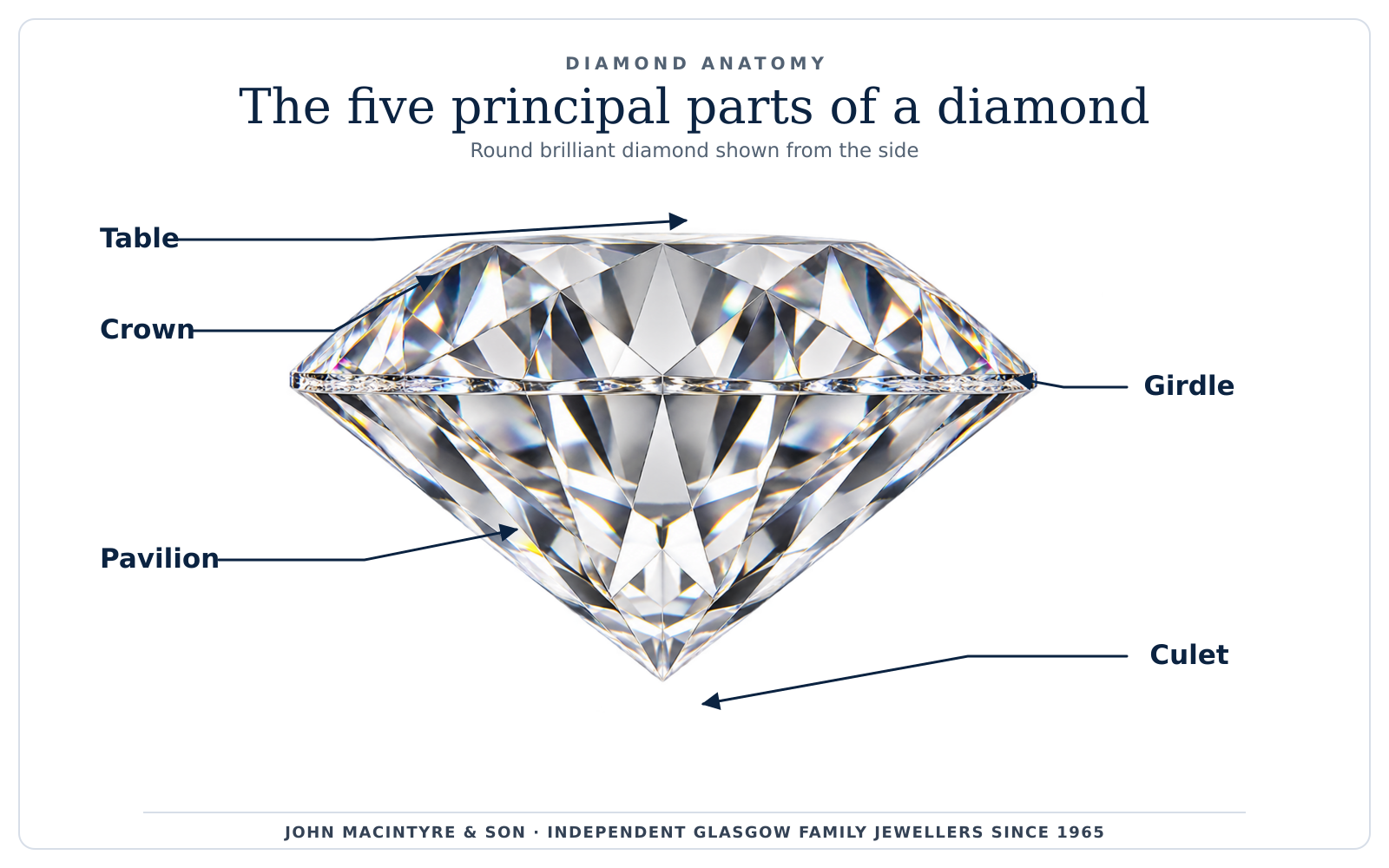
These are the principal sections used to describe a cut diamond.
Table
The largest facet on the top of the diamond. In a round brilliant diamond, table size is expressed as a percentage of the average girdle diameter.
Crown
The upper section between the girdle and the table. Its facets help shape the way light leaves the diamond as brightness, fire and scintillation.
Girdle
The outer edge where the crown and pavilion meet. It forms the diamond’s perimeter and is usually the area held by the setting. Girdle thickness affects durability and weight distribution.
Pavilion
The lower section beneath the girdle. Pavilion depth and angle have a major influence on whether light returns through the crown or escapes through the stone.
Culet
The point or very small facet at the base of the pavilion. A small facet can help reduce the risk of damage to a sharp point, while a noticeably large culet can affect the face-up appearance.
Understanding the facets
Facets are the flat, polished surfaces cut onto a diamond. Their size, shape, placement and alignment work together to control how light enters, travels through and leaves the stone.
A standard round brilliant usually has 57 or 58 facets, depending on whether the culet is counted as a facet. Other diamond shapes use different facet arrangements. For example, emerald cuts use long step facets that tend to produce broader flashes of light, while radiant cuts use a brilliant-style arrangement that creates a livelier pattern of smaller flashes. Even diamonds of the same shape and carat weight can look noticeably different because variations in their facet pattern, proportions and alignment affect how they return light.
How a diamond interacts with light
Select each term to explore it. These effects are influenced by the diamond’s proportions, facet relationships, symmetry, polish and the lighting and viewing conditions. No single measurement should be judged in isolation.
Brightness
The white light returned to the viewer from the diamond and its surroundings.
Fire
Flashes of spectral colour created when white light is separated into its component colours.
Scintillation
The pattern of light and dark flashes seen as the diamond, the viewer or the light source moves.
Contrast
The balanced pattern of bright and dark areas that gives the diamond definition and life.
Light leakage
Light that escapes from areas of the diamond instead of returning to the viewer. Some contrast is necessary; excessive leakage can make areas appear dull or transparent.
How diamond proportions are measured
Proportions describe the relationships between a diamond’s measurements and angles. A grading report may include some or all of the following:
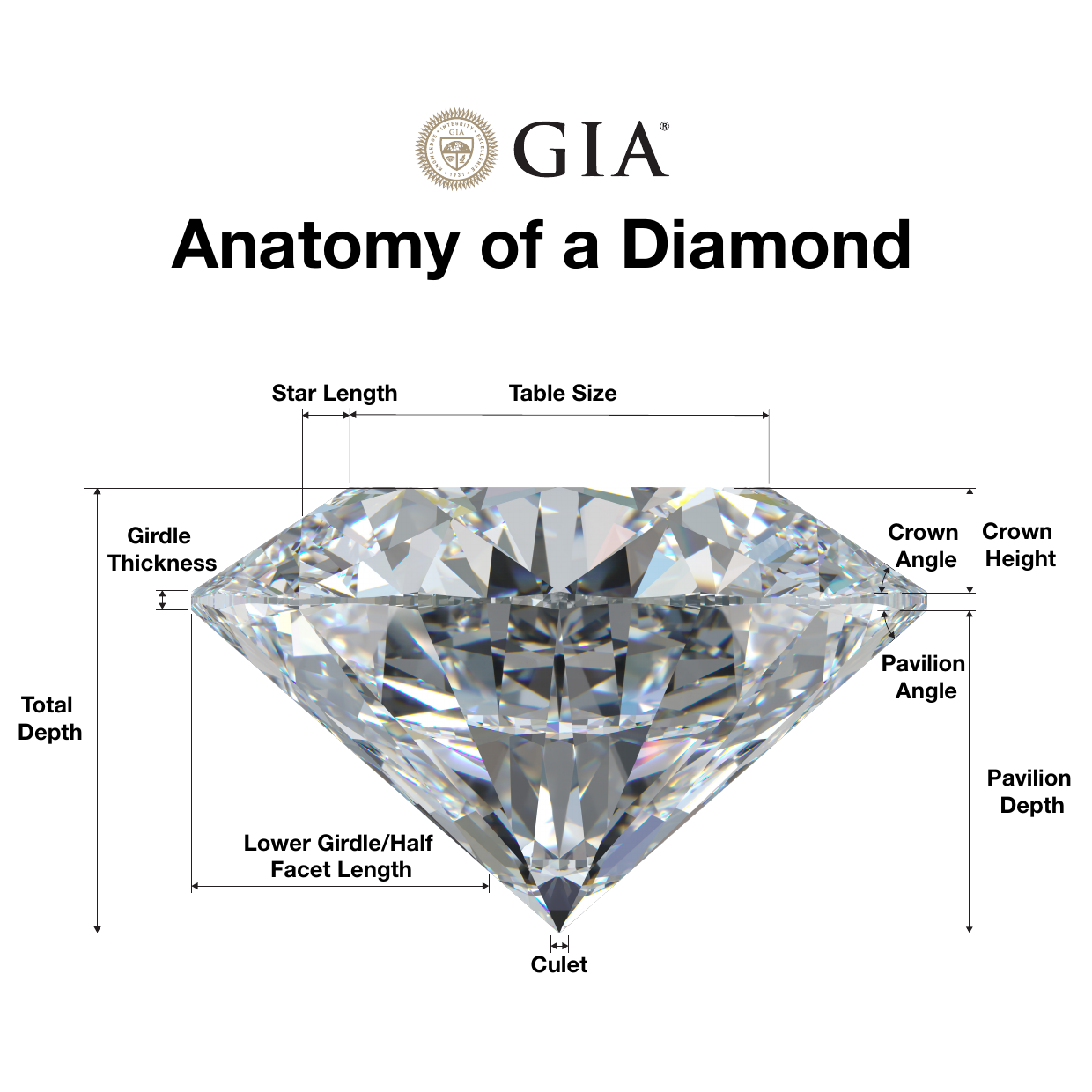 GIA anatomy diagram showing the proportions and measurements of a round brilliant diamond. Image courtesy of GIA.
Measurements shown on the diagram
- Table percentageThe width of the table expressed as a percentage of the diamond’s average girdle diameter.
- Total depth percentageThe diamond’s total depth from table to culet, expressed relative to its average girdle diameter.
- Crown height and crown angleMeasurements of the upper section above the girdle that help influence brightness, fire and overall appearance.
- Pavilion depth and pavilion angleMeasurements of the lower section beneath the girdle that have a major influence on light return and leakage.
- Girdle thicknessThe thickness of the diamond’s outer edge, which affects durability and how weight is distributed.
- Star length and lower-girdle facet lengthThe proportions of particular facet groups that help shape the pattern of light and dark and the diamond’s scintillation.
- Culet sizeThe size of the point or small facet at the base of the pavilion; a noticeably large culet may be visible face-up.
For a round brilliant diamond, table and depth percentages are calculated in relation to the average girdle diameter. These numbers help describe the diamond, but their effect depends on how they work together across the whole stone.
Cut is not the same as shape
Shape describes the outline of a diamond – for example round, oval, pear, emerald or cushion. Cut describes the diamond’s proportions, facet relationships, symmetry and polish, and how successfully these elements work together.
For mined diamonds in its D-to-Z colour range, GIA provides an overall cut grade only when the diamond is a standard round brilliant. Diamonds in other shapes, such as oval, pear, emerald, cushion and radiant, are commonly called fancy shapes. Standard GIA grading reports for these diamonds include separate grades for polish and symmetry, but not an overall cut grade. Their proportions, facet arrangement and face-up appearance should therefore be assessed carefully rather than relying on a single measurement or label.
GIA now uses a separate Premium or Standard quality assessment for colourless to near-colourless lab-grown diamonds, rather than the same grading terminology used for mined diamonds.
Explore diamond shapes, cut styles and cut quality.
IGI, which John Macintyre & Son uses for lab-grown diamonds, has a different grading system. It provides an overall cut grade for round brilliant diamonds and also offers overall cut grading for fancy shape diamonds, although this assessment is optional.
For fancy shape diamonds, IGI grades cut from Excellent to Poor using a four-step process. It grades polish and symmetry, checks proportions against guidelines for the particular shape, assesses shape-specific craftsmanship such as bow ties and girdle variation, and then evaluates overall light return. This final stage is not a separate assessment of fire or scintillation. A fancy shape diamond receives an overall Excellent cut grade only if it satisfies all four stages.
Because IGI’s fancy shape cut grading is optional, some reports include an overall Cut Grade while others show only the separate polish and symmetry grades. Reports issued before IGI introduced fancy shape cut grading in September 2022 may also lack one. The absence of an overall Cut Grade should not be interpreted as a poor cut grade.
Cut information should therefore always be read within the grading laboratory’s own system and in the context of the individual report.
Why diamond anatomy matters in everyday wear
Diamond is exceptionally hard, meaning that it is highly resistant to scratching, but hardness is not the same as toughness – a material’s ability to resist chipping or breaking. A sharp impact can chip a diamond, particularly near a very thin girdle, an exposed culet or the points and corners of certain shapes.
A well-chosen setting helps protect vulnerable areas. Claws, bezels and other setting components also wear over time, especially on a ring worn every day. Periodic inspection can identify worn claws, movement in a stone or other signs that maintenance may be needed before a diamond is lost or damaged.
If your ring was purchased from John Macintyre & Son, we provide a free diamond cleaning service and will check the ring for signs of wear. Additional services, such as polishing gold or platinum rings and rhodium plating white gold, are available for a small charge.
Continue exploring diamond quality
Understanding a diamond’s anatomy provides a useful foundation. Continue by exploring how colour, clarity, cut and carat weight are assessed and compared.
Written and reviewed by Jennifer, Sales Manager at John Macintyre & Son.
Last reviewed: October 2026