Two very different journeys. Both extraordinary in their own way.
Mined and lab-grown diamonds have very different stories. A mined diamond may have taken billions of years to form deep within the Earth, shaped entirely by Mother Nature. A lab-grown diamond is created using advanced technology; growth typically takes several days to several weeks, depending on the method, desired size and quality. Although their origins differ, both are diamonds, sharing essentially the same chemical, physical and optical properties.
At John Macintyre & Son, we love and embrace both. Since 1965, we have helped customers choose diamonds for life’s most important moments. That love of diamonds, together with our knowledge and careful eye for quality, lies behind our long-standing name, The King of Diamonds. We do not believe one origin is right for everyone. Our role is to explain the differences honestly, assess every diamond carefully and help you choose the one that feels right for you.
Mined & Lab-Grown
Two diamonds.
Two remarkable origins.
Mined and lab-grown diamonds can look identical in everyday viewing. Their origin and growth history differ, but the properties that define diamond are shared.
Mined✦Both arediamonds✦
Lab-grown What they share
These essential diamond properties are shared by both origins.
- Diamond
- Crystallised carbon
- Mohs hardness
- 10
- Refractive index
- 2.42
- Crystal structure
- Cubic
- Relative density
- 3.52
- Professional gemmological testing
- Confirms origin
How they differ
Select each point to reveal a short, honest explanation.
MinedLab-grown
Most mined diamonds formed around 150–200 kilometres below the Earth’s surface, and some were carried upwards by fast-rising kimberlite or related volcanic eruptions. Lab-grown diamonds are produced from a diamond seed using one of two principal methods: HPHT or CVD. Each method creates conditions in which carbon can crystallise as diamond.
Lab-grown diamond growth typically takes several days to several weeks, depending on the method, desired size and quality. Mined diamonds formed over immense geological time deep within the Earth.
Yes. When comparing diamonds with broadly comparable specifications, lab-grown diamonds cost less than mined diamonds. The price difference often becomes more noticeable as carat weight increases. A fair comparison should consider the full diamond specification, including shape, carat weight, colour, clarity, cut or proportions, polish, symmetry and fluorescence.
There is no universal winner. The best choice is the diamond that suits the wearer, the ring and the priorities behind the purchase.
We offer GIA graded mined diamonds and IGI graded lab-grown diamonds. Each grading report identifies the diamond’s origin and records its quality characteristics within that laboratory’s own grading system.
✦
One is a wonder of nature. The other is a triumph of science.
Both deserve an honest explanation—so you can choose with confidence.
Watch GIA Explain the Difference
This short film from the Gemological Institute of America (GIA) explains how diamonds formed within the Earth and diamonds grown in a laboratory are created, and how professional gemmological laboratories identify the difference.
Video from GIA
Natural vs Lab-Grown Diamonds
Loading video…
Video from GIAEnable Functional cookies to watch this Vimeo video.
The Same Diamond Material with a Different Origin
A lab-grown diamond is not an imitation. Mined and lab-grown diamonds are both crystallised carbon arranged in the same cubic crystal structure, with essentially the same chemical, physical and optical properties. Their origin and growth history differ, but the properties that define diamond are shared.
Hardness is one of those shared properties, but it describes resistance to scratching rather than resistance to impact.
What Gives Diamond Its Distinctive Properties
Select each heading to reveal more information.
Composition and colour
Diamond is the only major gemstone composed of a single element: carbon. Trace atoms and crystal defects can influence colour: nitrogen may contribute yellow or brown tones, while boron can produce blue. These are examples; diamond colour has other causes too.
Crystal form
Mined and lab-grown diamonds share the isometric, or cubic, crystal system. Their rough crystal shapes reflect their growth conditions: mined diamonds commonly form octahedra, HPHT-grown diamonds often show cubic and octahedral faces, and CVD-grown diamonds commonly grow as tabular plates.
Light and lustre
Diamond has a refractive index of about 2.42 and dispersion of about 0.044. Together with proportion and finish, these properties contribute to brilliance and fire. Its bright surface sheen is called adamantine lustre.
Density
Diamond has a specific gravity of about 3.52.
Birefringence
Diamond is normally singly refractive, though internal strain can produce anomalous birefringence.
Thermal conductivity
Diamond conducts heat exceptionally well. Thermal testers can distinguish diamonds from many simulants, but they cannot distinguish mined from lab-grown diamonds; moissanite can also give a diamond-like thermal reading. Checking origin requires other screening tests or laboratory analysis.
Fluorescence
Some diamonds emit visible light under long-wave ultraviolet light, most commonly blue, though other colours occur.
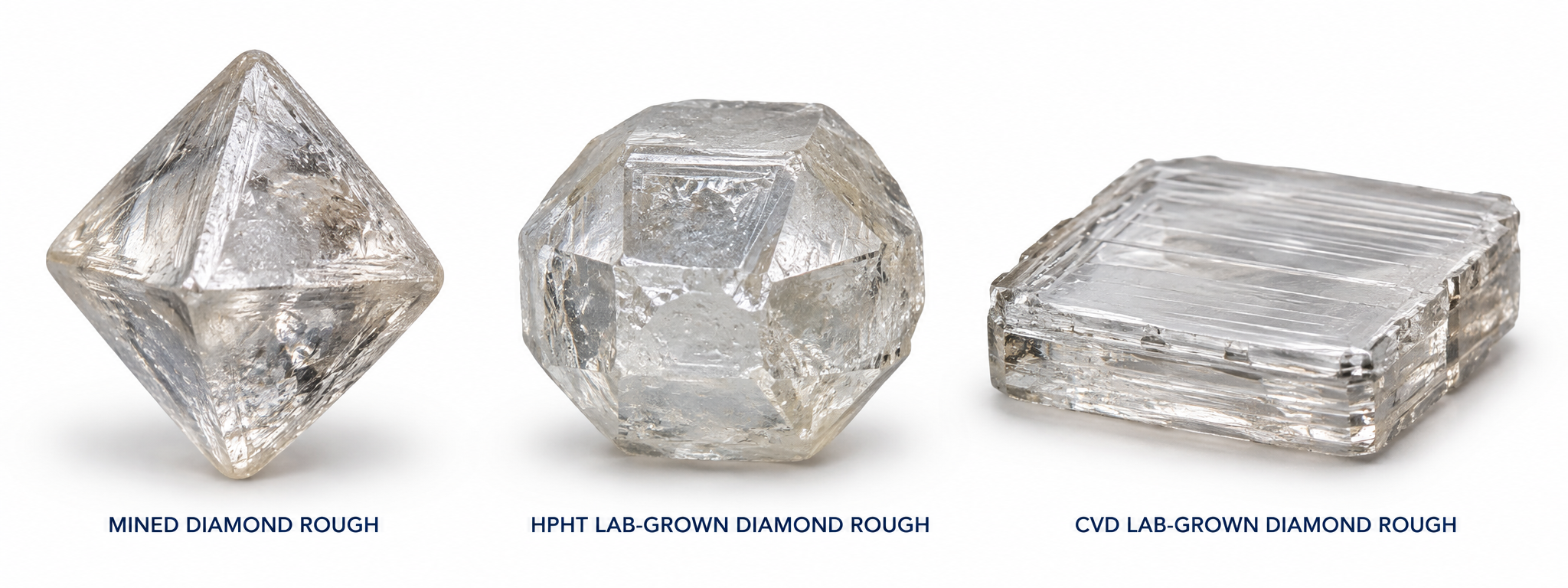 Typical examples of rough diamond growth morphology. Individual crystals vary, and origin cannot be determined conclusively from shape alone.
Diamond Anatomy Uses a Shared Industry Language
Mined and lab-grown diamonds are described using the same established diamond-anatomy terminology. The table, crown, girdle, pavilion and culet name the principal parts of a cut diamond, while measurements such as star length and total depth describe aspects of its proportions. These terms describe the diamond’s structure rather than its origin, so they apply equally when discussing GIA graded mined diamonds and lab-grown diamonds graded by the International Gemological Institute (IGI).
GIA established the modern 4Cs framework of cut, colour, clarity and carat weight. Other major gemmological laboratories, including IGI, use the same core diamond-anatomy language, although their diagrams and grading-report formats may present the information differently.
Diamond AnatomyView the labelled GIA diagram
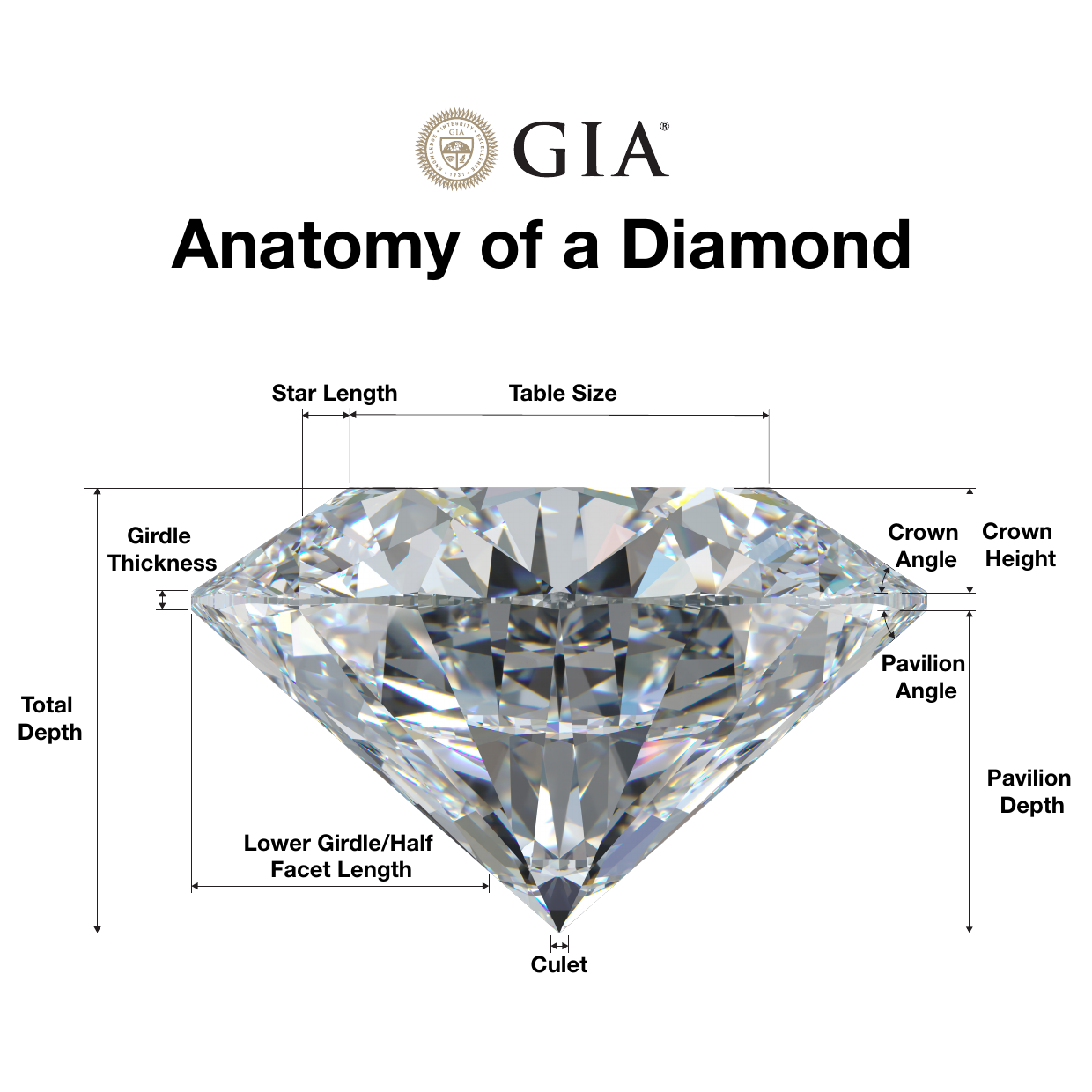 Anatomy of a Round Brilliant diamond. Image courtesy of GIA.
How Mined Diamonds Form
Most mined diamonds formed deep in the Earth’s mantle, commonly around 150–200 km below the surface, where heat and pressure transformed carbon over geological time. Some were carried towards the surface by fast-rising kimberlite or related volcanic eruptions. Their exact growth conditions and carbon sources vary. Each is an ancient creation of Mother Nature, individual in character and almost beyond imagination in age.
Mined Diamond FormationFrom deep within the Earth to the surface
How Lab-Grown Diamonds Are Made
Although lab-grown diamonds feel modern, their story began in the 1950s, when scientists first succeeded in producing diamonds in a laboratory, principally for industrial use. It took decades of research and refinement to grow diamonds consistently in the sizes and qualities suited to fine jewellery. As the technology improved and became more widely available, gem-quality lab-grown diamonds became more accessible and grew into an important part of today’s diamond market.
Lab-grown diamonds are produced using two main methods: High Pressure High Temperature (HPHT) and Chemical Vapour Deposition (CVD). For jewellery-quality diamonds, growth typically takes several days to several weeks, depending on the method, desired size and quality. The controlled process does not guarantee a particular quality. Colour, inclusions, proportions and cutting quality vary, so the individual diamond and its grading report matter.
HPHT and CVD Growth Processes
The diagrams below show simplified versions of the two main lab-grown diamond growth methods. Select either process to explore it. Conditions vary between stones and producers.
HPHT GrowthHigh Pressure High Temperature
A temperature gradient carries dissolved carbon through the molten metal flux towards the cooler seed, where it crystallises. The diagram is simplified; equipment and conditions vary.
CVD GrowthChemical Vapour Deposition
CVD grows diamond from carbon-containing gas in a low-pressure chamber, without the metal flux used in HPHT. Gas mixtures and operating conditions vary between producers.
Quality Still Comes Down to the Individual Diamond
Origin does not decide how beautifully a diamond performs. The 4Cs of cut, colour, clarity and carat weight help describe its quality, but each C answers a different question.
- Cut describes how well a diamond has been proportioned and finished. It has a major influence on brightness, fire and scintillation.
- Colour describes how colourless a diamond appears within the relevant grading scale.
- Clarity records internal and external features examined under controlled conditions and magnification.
- Carat is a measure of weight, not a guarantee of visible size or beauty.
Two diamonds with the same carat weight can look very different. Measurements, proportions, shape, cut quality and the way the stone handles light all affect its appearance. This is why we assess more than the number on the label. A cut grade is a useful summary, but it cannot show every light-and-dark contrast pattern as a diamond moves. GIA’s June 2026 cut research discusses this changing appearance; it is research commentary, not a new grading scale.
Explore the 4Cs with GIA
Learn how colour, clarity, cut and carat weight describe diamond quality, then compare individual grades using GIA’s interactive sliders.
Why We Use GIA for Mined Diamonds and IGI for Lab-Grown Diamonds
Independent grading has always been central to how we sell diamonds. It is the principle behind our Honest Diamond Grading campaign: customers should be able to see an impartial record of a diamond’s identity and quality rather than rely on a retailer’s description alone. For mined diamonds, we have long championed GIA. GIA created the 4Cs framework used throughout the industry, and its Diamond Grading Report provides an independent assessment of the stone’s quality characteristics.
As lab-grown diamonds became an increasingly important part of the market, we wanted to bring the same philosophy to our lab-grown diamond collection. IGI pioneered lab-grown diamond grading in 2005 and is one of the field’s leading laboratories. Its Laboratory Grown Diamond Report identifies the stone as lab-grown and records the detailed 4Cs information we want our customers to see, together with measurements, finish and other relevant details. That specialist history and report detail are why we pair our carefully selected lab-grown diamonds with IGI grading.
Where a laser inscription is present, we check its number against the report for that individual diamond. For mined diamonds, this is the GIA Diamond Grading Report; for lab-grown diamonds, it is the IGI Laboratory Grown Diamond Report. The inscription is microscopic and is normally viewed under magnification. Although 10x magnification may be sufficient, at John Macintyre & Son we often use 20x magnification to make the inscription easier to see. We compare the report details using the issuing laboratory’s online verification service. GIA has reported counterfeit report-number inscriptions that were not apparent on visual inspection, so an inscription alone cannot confirm a match.
Will a grading report show if a diamond has been treated?
A recognised gemmological laboratory examines a diamond for identity, origin and treatments and records relevant findings according to its own reporting policy. GIA may issue reports for diamonds with stable treatments, such as laser drilling or HPHT processing, and clearly discloses these treatments. It does not issue grading reports for diamonds with nonpermanent or unstable treatments, such as coating or fracture filling. Report formats vary, so each report should be read within that laboratory’s own system.
Customers can independently confirm report details using GIA Report Check or IGI Verify Your Report.
Matching an Inscription to an IGI Report
Here is an example using one of our lab-grown oval diamonds, in stock when this report was prepared. The IGI Laboratory-Grown Diamond Report describes an Oval Brilliant weighing 1.82 ct, graded D colour and VVS2 clarity, with Excellent polish and symmetry and no fluorescence. The loose diamond is shown beside a magnified sample image of its girdle inscription. The inscription number LG732553420 matches the IGI report number. The report also records CVD growth and Type IIa. Availability may change.
IGI Laser Inscription ExampleView the diamond and its report number
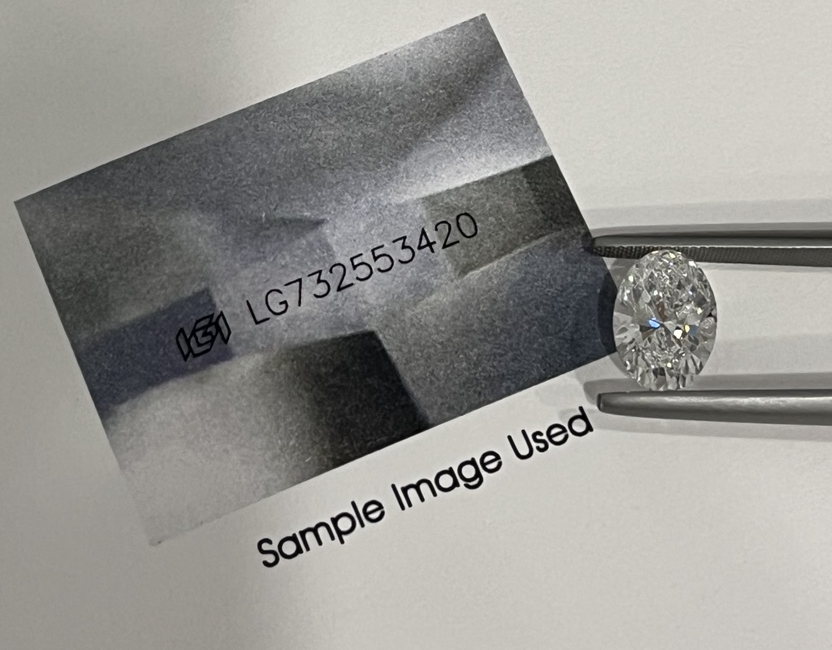 The loose oval in tweezers beside the magnified inscription image associated with its IGI report.
Matching IGI Grading ReportView the report for the same oval diamond
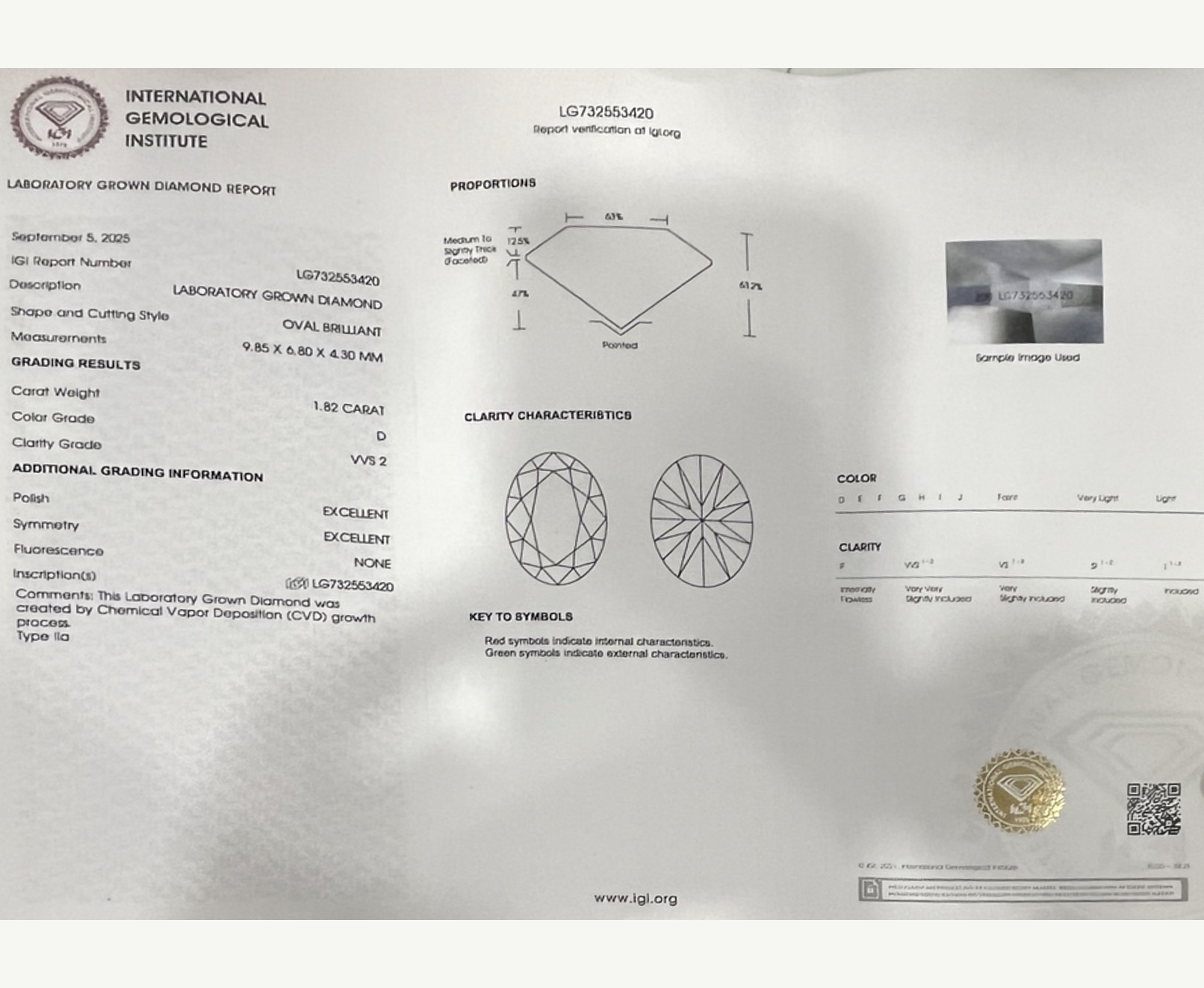 IGI Laboratory-Grown Diamond Report for the same oval. Report photograph supplied by John Macintyre & Son.
GIA Grading Report Video
Watch GIA explain how to read a Diamond Grading Report.
GIA grading report videoEnable Functional cookies to watch this video.
Grading laboratories do not all present lab-grown results in the same way. IGI continues to use detailed 4Cs reporting for lab-grown diamonds. On 2 June 2025, GIA announced that it would replace the colour and clarity grading terms previously used for lab-grown diamonds—which were originally developed for mined diamonds—with a two-tier quality assessment. The revised service launched on 1 October 2025 and classifies qualifying colourless-to-near-colourless lab-grown diamonds as Premium or Standard. A submitted diamond that does not meet all of GIA’s minimum criteria for Standard does not receive a GIA assessment. The formats should therefore be read on their own terms rather than compared as if they were identical. GIA’s revised Laboratory-Grown Diamond Report – Dossier omits growth type and post-growth treatment; other GIA report formats may include those details, so check the specific document.
GIA Lab-Grown Assessment ExampleView an example Premium result
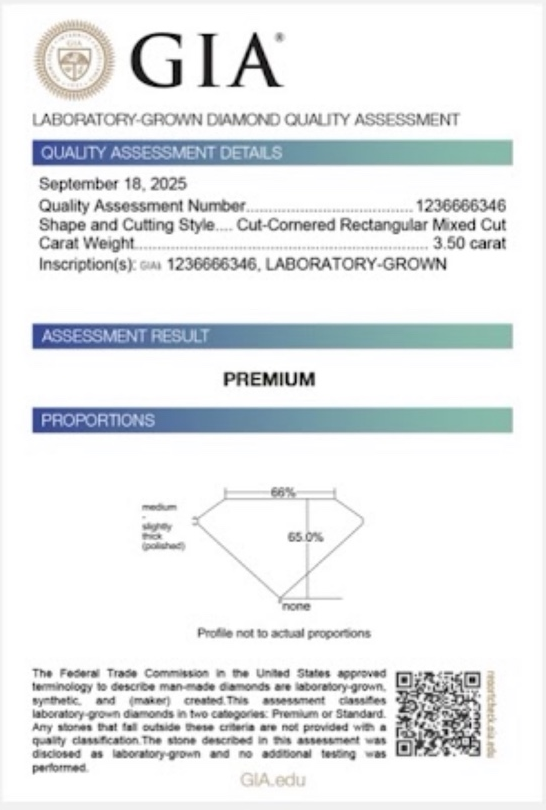 GIA Laboratory-Grown Diamond Quality Assessment example showing a Premium result. Image courtesy of GIA; shown for education and not as a report for a diamond offered by John Macintyre & Son.
Two Diamonds, Two Origins: Comparable Specifications
These loose round brilliant diamonds show how two stones with a similar colour, clarity and fluorescence profile can have different origins. Both are E colour, Internally Flawless and have no fluorescence. The mined diamond is graded by GIA; the lab-grown diamond is graded by IGI. Their reports should be read using each laboratory’s own grading terms.
Compare each detail below
IGI graded lab-grown diamond
GIA graded mined diamond
These separately recorded videos show two individually graded round brilliant diamonds with closely matched specifications: one mined and GIA graded, the other lab-grown and IGI graded. They illustrate how similar the two origins can appear, while professional testing and the accompanying grading report provide reliable identification.
Understanding the grading results
The GIA report describes the mined diamond as Excellent cut, Excellent polish and Excellent symmetry — often referred to in the trade as Triple Excellent. The IGI report describes the lab-grown diamond as Ideal cut, Excellent polish and Excellent symmetry.
GIA and IGI use the same core concepts when assessing polish, symmetry and fluorescence, but each laboratory applies its own grading procedures and standards. Their grade labels should therefore be read within the laboratory’s own grading system rather than treated as exact equivalents.
Practical Considerations
Price, future value, terminology and wider environmental or social considerations can all influence your decision. Select a subject below to explore it in more detail.
Price and Choosing Within Your Price Range
Lab-grown diamonds cost less than mined diamonds when their specifications are broadly comparable. The price difference often becomes more noticeable as carat weight increases. A fair comparison should consider the full diamond specification, including shape, carat weight, colour, clarity, cut or proportions, polish, symmetry and fluorescence. For elongated shapes, length-to-width ratio can also be relevant.
For many of our customers, this creates more freedom to choose a higher colour or clarity grade, a larger centre stone, diamond-set shoulders, or a platinum or 18ct gold setting. With precious-metal prices remaining high, lab-grown diamonds have also helped us offer a wider choice of rings below £2,000.
A mined diamond’s price reflects a different supply journey, including exploration, recovery and sorting, as well as the relative scarcity of particular combinations of size and quality. Customers may value its geological origin, age and established place in jewellery tradition.
We do not publish a fixed percentage saving because diamond prices change and fair comparisons must include the complete diamond specification, report, metal and setting. A very large diamond is not automatically the best diamond for your ring. Whether you choose mined or lab-grown, we aim to provide exceptional quality at an exceptional price.
Value and Resale
We believe a diamond ring should be chosen for beauty, meaning and suitability rather than a promised investment return. Mined diamonds have a longer-established secondary market, while lab-grown prices have changed quickly as production has expanded. Neither origin should be sold with a guarantee that it will rise in value, and jewellery commonly resells for less than its original retail price. Our focus is the value you receive when you buy: a carefully selected diamond, a high specification and a highly competitive price. We believe that is a more honest measure of value than making promises about what any diamond may be worth in the future.
Environmental and Social Considerations
We believe there is no responsible basis for saying that every lab-grown diamond is automatically sustainable or that every mined diamond has the same impact. The answer depends on the producer, energy source, mine, working practices, traceability and wider supply chain.
Diamond mining changes land and uses resources, but well-managed diamond industries can also support employment, local businesses and public revenue. Botswana is an important example of a country where diamond income has played a central role in national development. Those benefits depend on governance and how revenue is invested; they cannot be assumed for every diamond or every producing country.
Lab-grown production avoids mining the centre stone, but it requires substantial energy. Its footprint can vary greatly depending on how efficiently the facility operates and whether its electricity comes from renewable or fossil-fuel sources. Any specific environmental claim should be supported by evidence for that producer rather than applied to the whole category.
A grading report documents identity and quality characteristics. It does not, by itself, prove every ethical, environmental or labour claim about a diamond’s full supply chain.
The setting also has an environmental footprint. Gold and platinum are mined materials, whether the centre diamond is mined or lab-grown. Recycled precious metals can reduce demand for newly mined material, but no ring should be described as impact-free without evidence covering the full supply chain.
A Note on the Words Used
You may see the terms lab-grown diamond, laboratory-created diamond or synthetic diamond. In gemmology, synthetic describes a material made by people with essentially the same chemical and physical properties as its mined counterpart. It does not mean cubic zirconia, moissanite or a fake diamond.
Terminology differs between countries and industry organisations, and it continues to evolve. We use lab-grown diamond because it is clear, familiar to our customers and consistent with the wording we use in-store and online. Whatever term is used, the origin should always be disclosed prominently.
Which Diamond Is Right for You
There is no universal winner. The best choice is the diamond that suits the wearer, the ring and the priorities behind the purchase. Sometimes the decision comes down to price range: after comparing the available options, you may find that either a mined or lab-grown diamond is the better fit. These questions can help you decide.
- Has the person wearing the ring expressed a preference for a mined or lab-grown diamond?
- Does geological origin and history carry particular meaning for you?
- Would you prefer to prioritise a particular carat weight or quality specification within your price range?
- Are you comparing complete specifications, measurements and reports rather than carat weight alone?
- Have you seen the diamond clearly in person or on video, and do its shape, measurements and proportions suit your chosen setting?
Choose in Glasgow or From Further Afield
At our appointment-based Glasgow showroom, we hold a carefully chosen selection of sample engagement rings so you can try different designs, diamond shapes and settings. You will be guided by one of our five specialists, each with more than 20 years’ experience helping customers choose diamonds and engagement rings. Most of our rings are made to order, with the centre diamond and mount selected separately around your preferred diamond origin, shape, carat weight, quality, precious metal and price range. This gives you a much wider choice than limiting you to ready-made rings in a display cabinet. It can also help you achieve a higher diamond specification or carat weight at a highly competitive price. Where suitable examples are available, we can compare mined and lab-grown diamonds and talk you through their grading reports before creating the ring that is right for you.
 Our appointment-based Glasgow showroom on Mitchell Lane.
If you are further afield, we offer the same personal guidance by telephone, email or WhatsApp. When possible, we will share the independent grading report, clear photographs and a video of the loose centre diamond before approval, so you can consider the individual stone and its specification wherever you are.
Whether you’re comparing mined and lab-grown diamonds or choosing a ring to suit your style and price range, our team is here to offer clear, personal guidance. Find out more about our history, our Glasgow showroom and the way we help customers choose on our About John Macintyre & Son page.
Frequently Asked Questions
Select a question to reveal the answer.
Are lab-grown diamonds real, and are they the same as cubic zirconia or moissanite?
Yes. A lab-grown diamond is a diamond with essentially the same chemical, physical and optical properties as a mined diamond. It is not a simulant. Cubic zirconia and moissanite are different materials that may resemble diamond.
Can you tell a mined and lab-grown diamond apart by looking?
Not reliably by eye. They can look the same in normal viewing. Professional gemmological laboratories use advanced instruments and a combination of tests to determine origin.
Does fluorescence reveal a diamond’s origin?
No. Both mined and lab-grown diamonds can fluoresce, so fluorescence alone cannot identify origin. Specialist laboratories may examine fluorescence and phosphorescence patterns alongside spectroscopy and other tests. Fluorescence does not weaken the diamond.
Are all lab-grown diamonds flawless?
No. Lab-grown diamonds can have inclusions, colour and growth features, and they vary in cut quality. Each diamond should be assessed individually.
Are both mined and lab-grown diamonds suitable for an engagement ring?
Yes. Both are durable diamonds suitable for everyday jewellery. The right choice depends on the intended wearer’s preference, the meaning you attach to origin, your price range and the specification you want.
Ready to Compare Mined and Lab-Grown Diamonds?
Tell us what matters most to you, and we’ll help you compare suitable diamonds, review their grading reports and choose the one that feels right. Visit our Glasgow showroom by appointment, or contact us by phone, email or WhatsApp if you’re further afield.
Make an Engagement Ring Enquiry
Written and reviewed by Jennifer, Sales Manager at John Macintyre & Son.
Last reviewed: October 2026